
What does the word “Far” mean in “Far Infrared”? Why is that important?
Far infrared is a type of infrared* that operates in the wavelengths above 3,000 nm. Also known as IRC and long wave, far infrared heating elements emit temperatures typically around the 100°C mark and have no visible light. Far infrared is the wavelength we are most interested in for human comfort because skin content is 80% water which absorbs heat most efficiently from wavelengths of 3 microns and lower (Far Infrared). This long wave, far infrared is better absorbed by the skin, is less transmissive (passes through) and is less reflected.. Far infrared is commonly used for heating homes as well as in infrared saunas and in the wellness sector. Infrared radiation is a perfectly harmless, natural form of radiation. In fact, it is recognised for its health benefits through deeper muscle warmth, in turn supporting flexibility and improved circulation.
Why do we perceive these far infrared rays as heat?
When far infrared rays strike an object they force the molecules in that object to vibrate. That vibration causes the object to warm-up– i.e to “heat”. The object warms up until its molecules are oscillating at the same frequency as the source.
Conversely, if the source then disappears, or operates sporadically, those objects then radiate out their own infrared heat. This effect is the same for humans as it is for objects. We experience absorbing infrared heat as ‘warming up’ and loss of infrared heat as ‘cooling down’.
If our environment is radiating more than we are (e.g. warm walls), we absorb the radiation and consequently feel warm. If our environment is radiating less than we are (e.g. cold walls), we feel cold, because we’re radiating out to it.
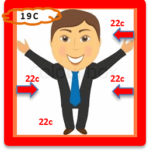
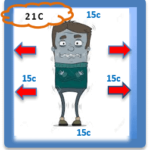
Why is it possible on a cold, sunny mountainside for people to feel warm?
Like the surface of the earth, humans naturally absorb infrared heat, if it’s available, regardless of the surrounding air temperature.

- Humans can feel warm in a “radiant” environment, when the air itself is cold because we absorb the radiation from our environment regardless of the air temperature (like skiers on a sunny mountainside).
- Conversely in a cold environment when the air is warm, humans still feel “cold” because they radiate out infrared. Police helicopters use infrared cameras to detect humans because at night time, against a cold environment, humans radiate more infrared heat than they absorb from their environment, and ‘stand-out’.
An experiment at the John B. Pierce Laboratory, USA, clarified this human perception of radiant heat.
“Test persons in a room with a temperature of 50°C (122°F) of warm air and cooled walls felt frozen; whilst in a room with a temperature of 10°C (50°F) of cool air and warm walls, they broke into an unpleasant sweat.“
(Source: Techn. Info “Strahlungsenergie – die Ur-Energie, neu entdeckt, TT Technotherm GmbH, Nürnberg).
What is the most effective type of heating for heating humans?
The fundamental requirement for effective human heating is therefore whether the heat source is radiant or convective. A radiant source makes for a more effective heater because it warms the whole environment around the person, which then radiates back. A convective source only heats the air and not the environment – implying a) you can still feel cold in a convection-heated environment and b) as soon as the heater switches off, the air cools down very rapidly.
Understanding the difference in infrared wavelengths for heating.
*Infrared wavelengths themselves are divided into 3 distinct categories, due to the different physical characteristics of each wavelength.
“Near Infrared”, “IRA”, “Short wave” or “Bright” Infrared heaters and “Heat Lamps” operate between 780 nm to 1,400 nm and emit temperatures of 1300°C and more plus a certain amount of “deep red” visible light. Applications of this technology include heat lamps for food preparation; large volume “Space” heating requirements and certain carefully controlled medical applications.
“Medium Infrared”, “IRB” or “Medium Wave “ infrared heaters operate between 1,400 nm and 3,000 nm and emit temperatures in the high hundreds of °C. Middlewave is valuable for Space heating in cold locations or where there is a lot of airflow due to its more transmissive properties over Far Infrared.
“Far infrared”, “IRC”, “Long wave” or “Dark Radiators” operate in the wavelengths above 3,000 nm. Far Infrared elements emit much lower temperatures, typically around the 100°C mark and no visible light. This is the wavelength used in domestic “comfort” heating and Infrared Sauna applications.
Please also see FAQ on Are there any standards governing Far Infrared Panels?